
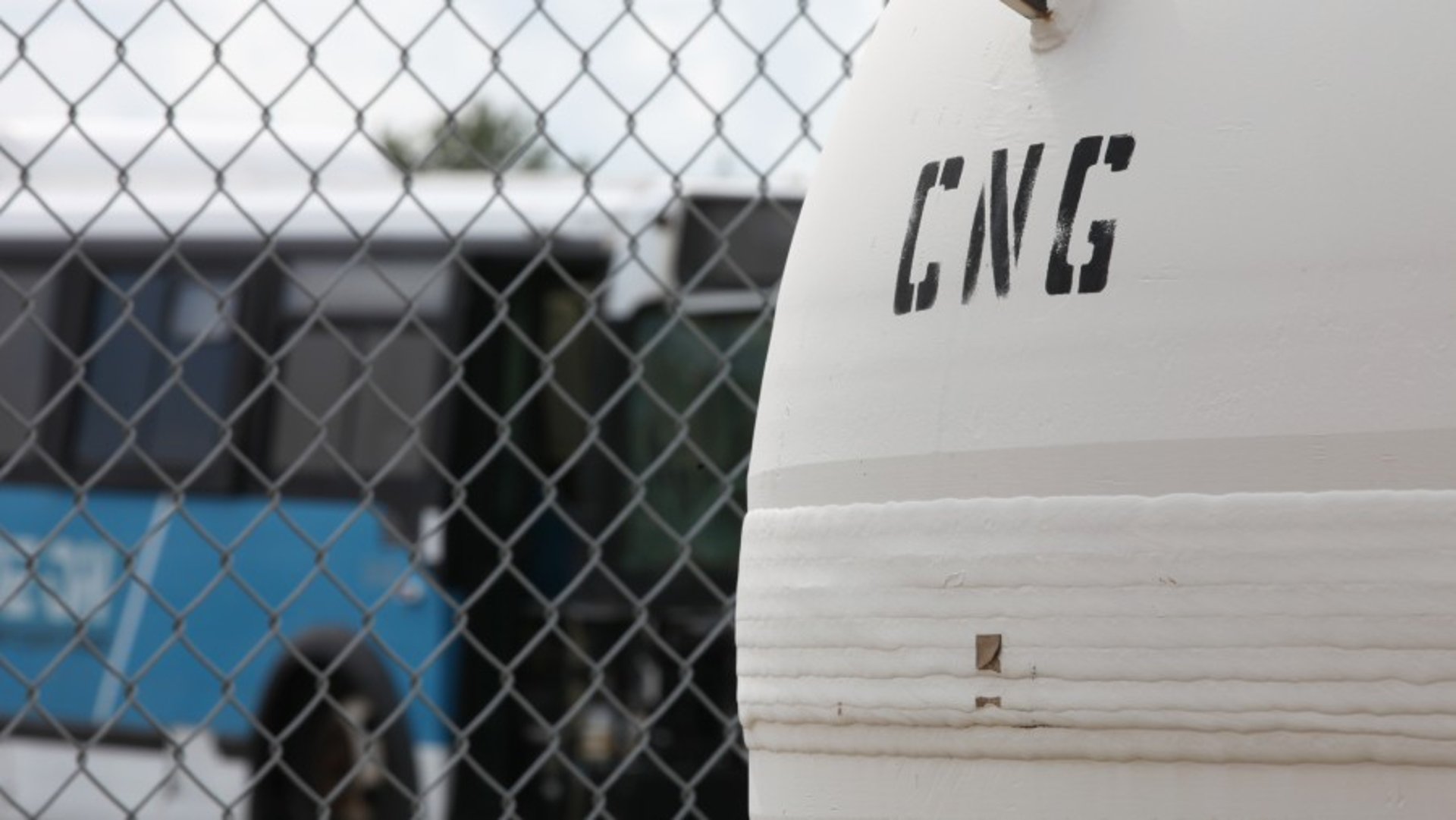
The Ministry of Energy and Mineral Resources (ESDM) is targeting the conversion of LPG to 3 kg CNG tanks to begin this year.
GAS INDUSTRY NEWS
Azura Yumna Ramadani Purnama (Bloombergtechnoz)
5/5/2026
The Ministry of Energy and Mineral Resources (ESDM) is targeting a program to convert liquefied petroleum gas (LPG) to compressed natural gas (CNG) in 3-kilogram (kg) cylinders this year.
The Director General of Oil and Gas at the Ministry of Energy and Mineral Resources, Laode Sulaeman, revealed that a pilot project will be implemented in major cities on the island of Java.
The pilot project is targeted to begin this year, primarily after the 3-kg CNG cylinder trial is completed within the next three months.
"The target is for public consumption this year. It will be rolled out gradually in major cities in Java first," Laode told the media in South Jakarta on Tuesday (May 5, 2026).
He indicated that the 3 kg CNG cylinders would use type 4 cylinders, or cylinders made of plastic or polymer and wrapped in composite or carbon fiber and fiberglass.
Regarding the roadmap for implementing the conversion, Laode stated that the Minister of Energy and Mineral Resources, along with the Directorate General of Oil and Gas, are still reviewing the roadmap and cannot yet announce it to the public.
Laode could not yet reveal the roles of PT Pertamina (Persero) and the private sector in the process of fulfilling natural gas supplies, CNG filling, and the distribution of 3 kg CNG canisters.
"I can't announce the plan yet. It's being drafted by a team, with the Minister leading it directly, so the Minister will announce it directly afterward. And regarding this, there's the cylinder preparation aspect and the distribution aspect, right? So, these things have to match," Laode said.
Previously, Energy and Mineral Resources Minister Bahlil Lahadalia admitted that he was conducting trials to develop CNG in 3-kg cylinders. He estimated the trials would take 2-3 months.
Bahlil stated that these trials were necessary because CNG's pressure is higher than that of LPG. He noted that CNG pressure in cylinders can reach 200 to 250 bar.
"Well, this is what we will try to modify. God willing, we will have the results in 2-3 months, and if it is declared firm, we will carry out the conversion," Bahlil told the media at the Presidential Palace on Tuesday (May 5, 2026).
He said that currently, several industries, such as hotels, restaurants, and Free Nutritional Meal (MBG) kitchens, are already using CNG as an energy source for cooking.
However, these industries use 20-kg CNG cylinders, while some use 10-kg cylinders.
"Well, for the 3-kilogram cylinder, trials are still underway because the pressure is very high, around 200 to 250 bar," Bahlil said.
Bahlil stated that, based on current studies, the use of CNG would be approximately 30% cheaper than LPG.
The reason is that Indonesia has a supply of natural gas containing C1, or methane, and C2, or ethane. These two components are the raw materials for CNG.
"Because first, the gas is available here, and the industry is here, domestically. So we don't have to import it. We can cover the transportation costs alone. And second, it's available in almost all regions with gas sources," he emphasized.
"So it's much more efficient. And if you ask whether it's already operational or not, it's already operational on a large scale," Bahlil continued.
Furthermore, Bahlil admitted that he was open to the option of subsidizing 3-kilogram CNG, even though the product is claimed to be 30% to 40% cheaper than LPG.
Bahlil admitted that he was still reviewing the potential subsidy amount per cylinder for the 3-kg CNG project. However, for comparison, he mentioned that the LPG subsidy would be around IDR 18,000-IDR 20,000 per cylinder.
"Everything is still being reviewed. The subsidy option is still a must; we just need to determine the volume," Bahlil said.
According to the Ministry of Energy and Mineral Resources (ESDM), CNG is a gaseous fuel made by compressing natural gas, consisting of C1, or methane, and C2, or ethane.
The CNG is then stored and distributed in pressure vessels or cylinders at high pressure, between 200 and 250 bar (equivalent to 2,900 and 3,600 psi).
The cylinders are also claimed to have a resistance of up to 650 bar, or 9,427 psi. This means that CNG cylinders will have a high tolerance for safety requirements.
The Ministry of Energy and Mineral Resources (ESDM) is targeting a program to convert liquefied petroleum gas (LPG) to compressed natural gas (CNG) in 3-kilogram (kg) cylinders this year.
The Director General of Oil and Gas at the Ministry of Energy and Mineral Resources, Laode Sulaeman, revealed that a pilot project will be implemented in major cities on the island of Java.
The pilot project is targeted to begin this year, primarily after the 3-kg CNG cylinder trial is completed within the next three months.
"The target is for public consumption this year. It will be rolled out gradually in major cities in Java first," Laode told the media in South Jakarta on Tuesday (May 5, 2026).
He indicated that the 3 kg CNG cylinders would use type 4 cylinders, or cylinders made of plastic or polymer and wrapped in composite or carbon fiber and fiberglass.
Regarding the roadmap for implementing the conversion, Laode stated that the Minister of Energy and Mineral Resources, along with the Directorate General of Oil and Gas, are still reviewing the roadmap and cannot yet announce it to the public.
Laode could not yet reveal the roles of PT Pertamina (Persero) and the private sector in the process of fulfilling natural gas supplies, CNG filling, and the distribution of 3 kg CNG canisters.
"I can't announce the plan yet. It's being drafted by a team, with the Minister leading it directly, so the Minister will announce it directly afterward. And regarding this, there's the cylinder preparation aspect and the distribution aspect, right? So, these things have to match," Laode said.
Previously, Energy and Mineral Resources Minister Bahlil Lahadalia admitted that he was conducting trials to develop CNG in 3-kg cylinders. He estimated the trials would take 2-3 months.
Bahlil stated that these trials were necessary because CNG's pressure is higher than that of LPG. He noted that CNG pressure in cylinders can reach 200 to 250 bar.
"Well, this is what we will try to modify. God willing, we will have the results in 2-3 months, and if it is declared firm, we will carry out the conversion," Bahlil told the media at the Presidential Palace on Tuesday (May 5, 2026).
He said that currently, several industries, such as hotels, restaurants, and Free Nutritional Meal (MBG) kitchens, are already using CNG as an energy source for cooking.
However, these industries use 20-kg CNG cylinders, while some use 10-kg cylinders.
"Well, for the 3-kilogram cylinder, trials are still underway because the pressure is very high, around 200 to 250 bar," Bahlil said.
Bahlil stated that, based on current studies, the use of CNG would be approximately 30% cheaper than LPG.
The reason is that Indonesia has a supply of natural gas containing C1, or methane, and C2, or ethane. These two components are the raw materials for CNG.
"Because first, the gas is available here, and the industry is here, domestically. So we don't have to import it. We can cover the transportation costs alone. And second, it's available in almost all regions with gas sources," he emphasized.
"So it's much more efficient. And if you ask whether it's already operational or not, it's already operational on a large scale," Bahlil continued.
Furthermore, Bahlil admitted that he was open to the option of subsidizing 3-kilogram CNG, even though the product is claimed to be 30% to 40% cheaper than LPG.
Bahlil admitted that he was still reviewing the potential subsidy amount per cylinder for the 3-kg CNG project. However, for comparison, he mentioned that the LPG subsidy would be around IDR 18,000-IDR 20,000 per cylinder.
"Everything is still being reviewed. The subsidy option is still a must; we just need to determine the volume," Bahlil said.
According to the Ministry of Energy and Mineral Resources (ESDM), CNG is a gaseous fuel made by compressing natural gas, consisting of C1, or methane, and C2, or ethane.
The CNG is then stored and distributed in pressure vessels or cylinders at high pressure, between 200 and 250 bar (equivalent to 2,900 and 3,600 psi).
The cylinders are also claimed to have a resistance of up to 650 bar, or 9,427 psi. This means that CNG cylinders will have a high tolerance for safety requirements.
Office:
Rasuna Office Park, 3rd Floor Unit TO-07
Complex Rasuna Epicentrum
Jl. HR. Rasuna Said, Kuningan, Jakarta 12960
Tel : +62 21 8378 3757, 8379 5203
Fax : +62 21 8378 1126, 8379 5302
Email : secretariat@indonesiangassociety.com
© 2014. Indonesian Gas Society. All rights reserved.
Mailing Address:
Jl.Kebon Baru 3 No.4 RT.03/RW.09 Tebet, Asem Baris,Jakarta Selatan, 12830