
Natural Gas as a Mainstay Amidst Crisis and Energy Transition Dilemma
NEWS
Dewi Kania (ekobiz.indozone.id)
9/18/2025
In its efforts to maintain national energy security while transforming towards clean energy, Indonesia faces significant challenges during the energy transition. Amidst the surge in renewable energy development, natural gas remains a key component in bridging the path to a more sustainable energy future.
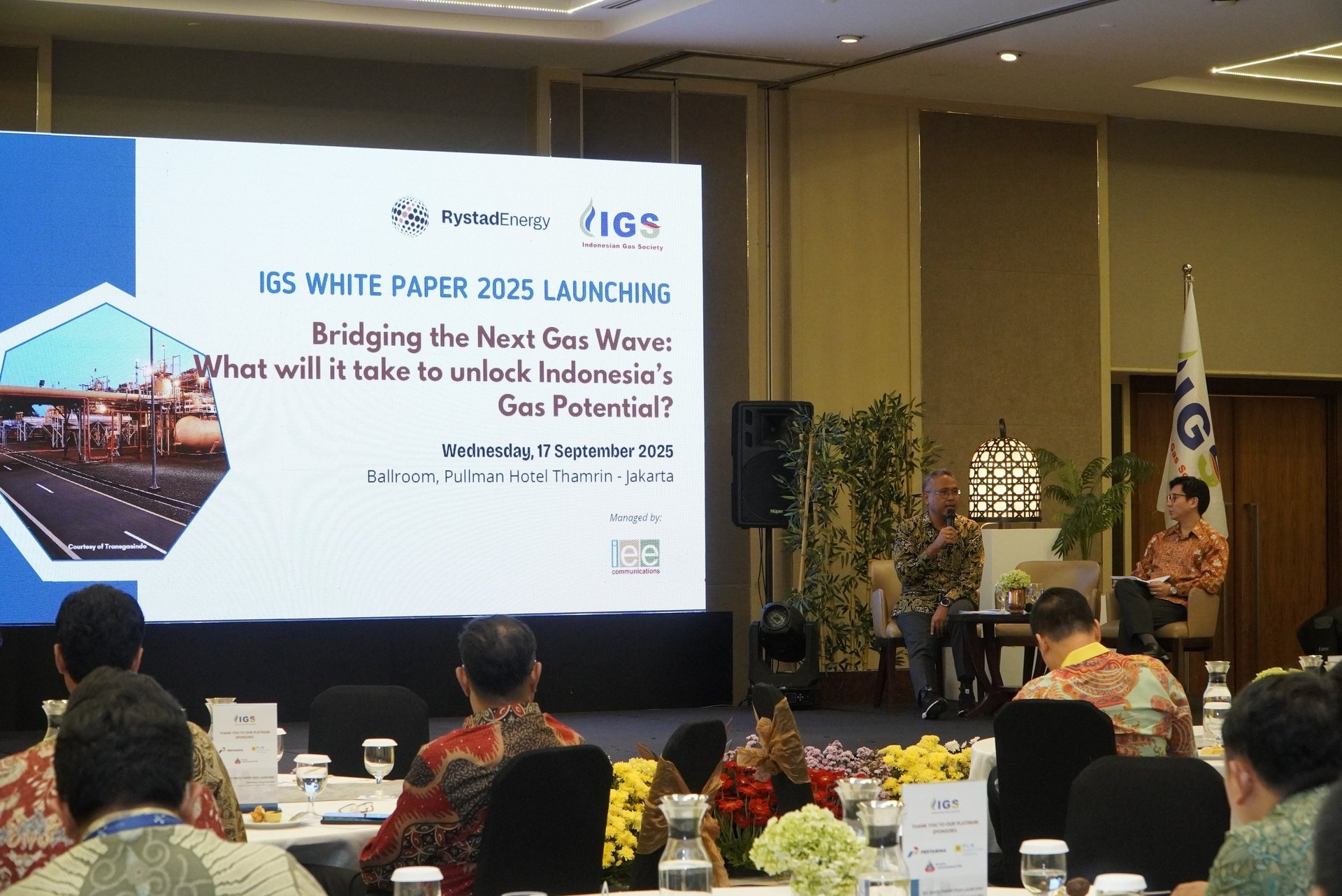
This view was affirmed at the launch of the IGS White Paper 2025, held by the Indonesian Gas Society (IGS) on Wednesday, September 17, 2025, in Jakarta. The white paper, titled "Bridging the Next Gas Wave: What Will It Take to Unlock Indonesia's Gas Potential?", maps out a data-driven strategy to strengthen the national natural gas ecosystem.
Renewable Energy Strategic Partner
IGS Advisor Daniel S. Purba explained that natural gas will not only continue to play a vital role in the national energy system but will also go hand in hand with the growth of renewable energy.
"Gas will remain a crucial pillar that works hand in hand with renewable energy," Daniel stated on the sidelines of the event.
Achmad Wijadja, Deputy Chairman for Advocacy and Industry at the Indonesian Chamber of Commerce and Industry (Kadin), also added that the IGS's focus is now on concrete policy implementation, starting from upstream-downstream efficiency, strengthening pipeline and LNG infrastructure, ensuring regulatory certainty, and adopting low-emission technologies.
"Investment in the gas sector requires long-term certainty. Without stable regulations and adequate infrastructure, industry will struggle to access energy at competitive prices," he added.
Gas Demand Predicted to Increase Sharply
A report from Rystad Energy reveals that domestic gas consumption is expected to surge from 3,630 mmscfd in 2025 to 4,830 mmscfd in 2035. This increase is largely driven by the industrial and electricity sectors, with Java and Sumatra remaining the centers of demand, representing approximately 70% of national consumption.
Strategic Projects to Maintain Supply
On the supply side, the natural decline in production from gas fields will be offset by several major projects such as the Indonesia Deepwater Development (IDD), Abadi LNG, and Andaman. Gas production is projected to increase from 4,970 mmscfd in 2027 to over 7,500 mmscfd in 2032, with these projects contributing more than 50% of national output by 2050.
Regasification Infrastructure in the Spotlight
However, a new challenge arises in the form of limited national regasification capacity. LNG demand is expected to exceed available capacity in the mid-2030s. Some terminals, such as those in West Java, are projected to operate almost fully, while the new terminal in Teluk Lamong, East Java, scheduled for completion in 2025, is expected to be insufficient to meet the surge in demand.
Price Stability and Energy Security
Although the gas pricing policy for the industrial and electricity sectors has been extended until 2029, the risk of fluctuations in global LNG prices that could disrupt domestic stability remains. As a precautionary measure, the government diverted seven LNG cargoes to the domestic market in April–May 2025.
Decarbonization and Strategic Measures
The decarbonization agenda is also highlighted in this white paper. Solutions such as biomethane, CCS/CCUS, CO₂ transport, hydrogen refueling, and the development of blue ammonia are being prepared to support a clean and sustainable energy transition.
Three short-term regulatory measures are also recommended: accelerating infrastructure development, aligning incentives and objectives for LNG procurement, and simplifying permitting through an integrated system.
Commitment to a Resilient Energy Future
Through this document, IGS emphasizes the importance of building data-driven policy dialogue and implementation. Natural gas is not only considered a transitional energy source, but also a strategic foundation for achieving a resilient and low-carbon national energy system.
"Regulation and infrastructure are key. Without them, it is difficult to maintain a balance between growing domestic demand and limited supply," he concluded.

>
Natural Gas as a Mainstay Amidst Crisis and Energy Transition Dilemma
>
>
In its efforts to maintain national energy security while transforming towards clean energy, Indonesia faces significant challenges during the energy transition. Amidst the surge in renewable energy development, natural gas remains a key component in bridging the path to a more sustainable energy future.
This view was affirmed at the launch of the IGS White Paper 2025, held by the Indonesian Gas Society (IGS) on Wednesday, September 17, 2025, in Jakarta. The white paper, titled "Bridging the Next Gas Wave: What Will It Take to Unlock Indonesia's Gas Potential?", maps out a data-driven strategy to strengthen the national natural gas ecosystem.
Renewable Energy Strategic Partner
IGS Advisor Daniel S. Purba explained that natural gas will not only continue to play a vital role in the national energy system but will also go hand in hand with the growth of renewable energy.
"Gas will remain a crucial pillar that works hand in hand with renewable energy," Daniel stated on the sidelines of the event.
Achmad Wijadja, Deputy Chairman for Advocacy and Industry at the Indonesian Chamber of Commerce and Industry (Kadin), also added that the IGS's focus is now on concrete policy implementation, starting from upstream-downstream efficiency, strengthening pipeline and LNG infrastructure, ensuring regulatory certainty, and adopting low-emission technologies.
"Investment in the gas sector requires long-term certainty. Without stable regulations and adequate infrastructure, industry will struggle to access energy at competitive prices," he added.
Gas Demand Predicted to Increase Sharply
A report from Rystad Energy reveals that domestic gas consumption is expected to surge from 3,630 mmscfd in 2025 to 4,830 mmscfd in 2035. This increase is largely driven by the industrial and electricity sectors, with Java and Sumatra remaining the centers of demand, representing approximately 70% of national consumption.
Strategic Projects to Maintain Supply
On the supply side, the natural decline in production from gas fields will be offset by several major projects such as the Indonesia Deepwater Development (IDD), Abadi LNG, and Andaman. Gas production is projected to increase from 4,970 mmscfd in 2027 to over 7,500 mmscfd in 2032, with these projects contributing more than 50% of national output by 2050.
Regasification Infrastructure in the Spotlight
However, a new challenge arises in the form of limited national regasification capacity. LNG demand is expected to exceed available capacity in the mid-2030s. Some terminals, such as those in West Java, are projected to operate almost fully, while the new terminal in Teluk Lamong, East Java, scheduled for completion in 2025, is expected to be insufficient to meet the surge in demand.
Price Stability and Energy Security
Although the gas pricing policy for the industrial and electricity sectors has been extended until 2029, the risk of fluctuations in global LNG prices that could disrupt domestic stability remains. As a precautionary measure, the government diverted seven LNG cargoes to the domestic market in April–May 2025.
Decarbonization and Strategic Measures
The decarbonization agenda is also highlighted in this white paper. Solutions such as biomethane, CCS/CCUS, CO₂ transport, hydrogen refueling, and the development of blue ammonia are being prepared to support a clean and sustainable energy transition.
Three short-term regulatory measures are also recommended: accelerating infrastructure development, aligning incentives and objectives for LNG procurement, and simplifying permitting through an integrated system.
Commitment to a Resilient Energy Future
Through this document, IGS emphasizes the importance of building data-driven policy dialogue and implementation. Natural gas is not only considered a transitional energy source, but also a strategic foundation for achieving a resilient and low-carbon national energy system.
"Regulation and infrastructure are key. Without them, it is difficult to maintain a balance between growing domestic demand and limited supply," he concluded.
>
Natural Gas as a Mainstay Amidst Crisis and Energy Transition Dilemma
>
>
Office:
Rasuna Office Park, 3rd Floor Unit TO-07
Complex Rasuna Epicentrum
Jl. HR. Rasuna Said, Kuningan, Jakarta 12960
Tel : +62 21 8378 3757, 8379 5203
Fax : +62 21 8378 1126, 8379 5302
Email : secretariat@indonesiangassociety.com
© 2014. Indonesian Gas Society. All rights reserved.


Mailing Address:
Jl.Kebon Baru 3 No.4 RT.03/RW.09 Tebet, Asem Baris,Jakarta Selatan, 12830