
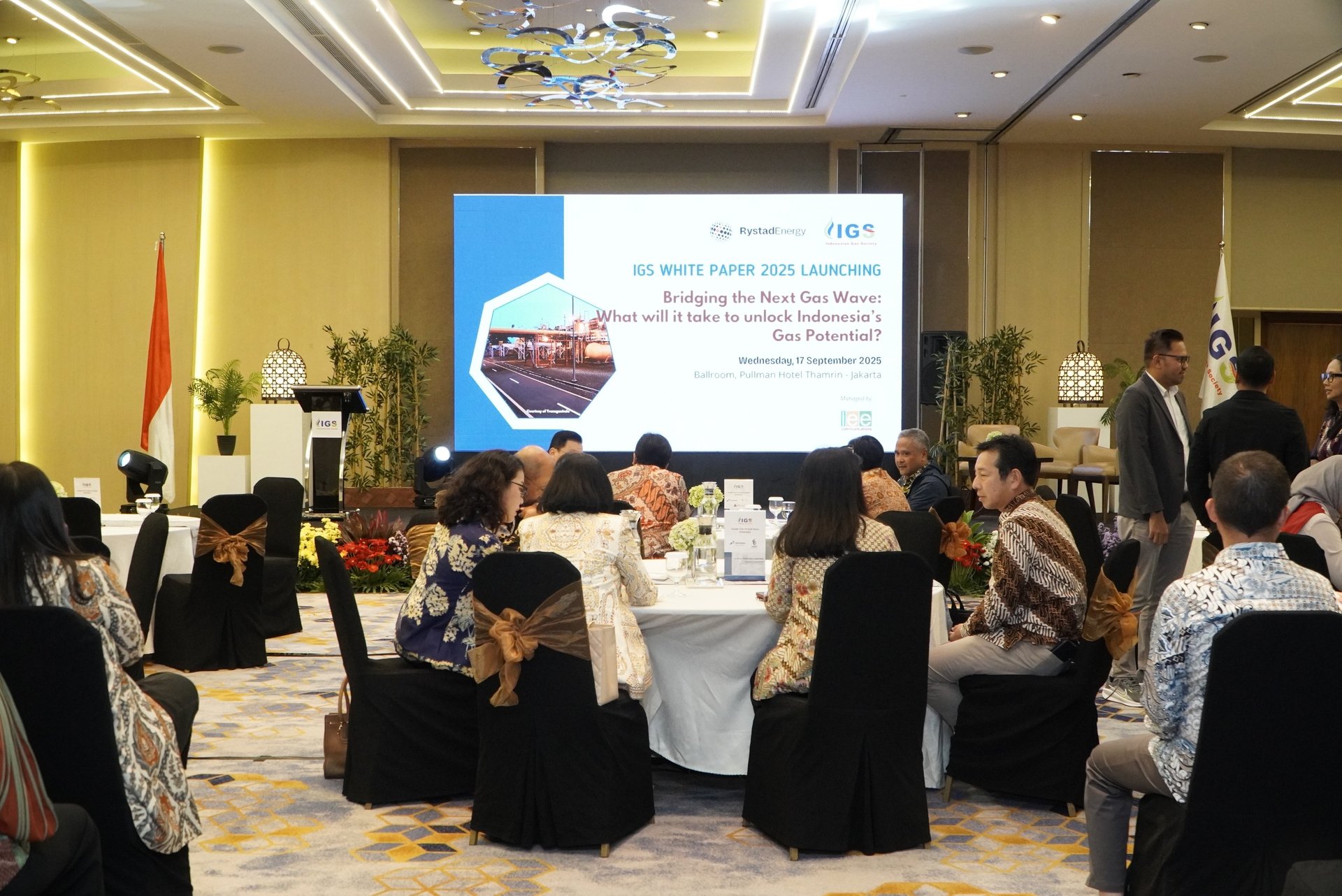
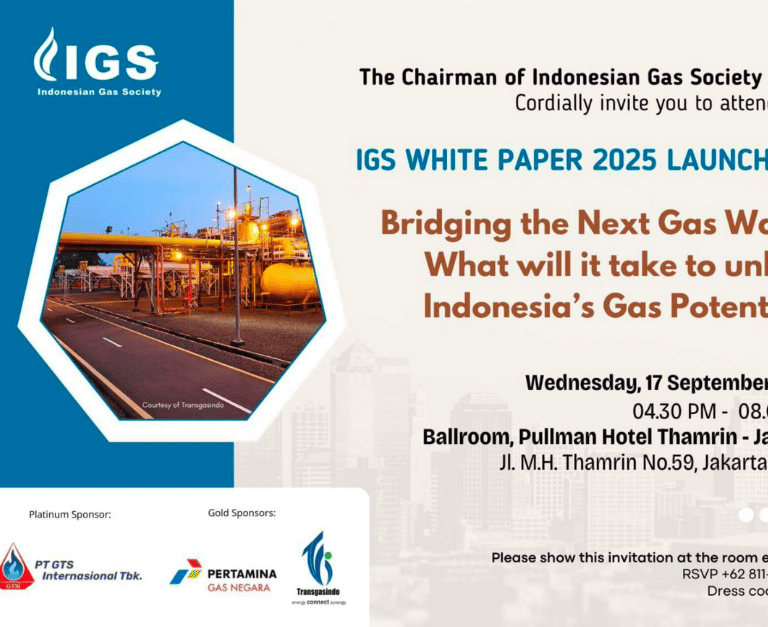
IGS White Paper 2025 Launching
17 September 2025, Pullman Hotel Thamrin - Jakarta
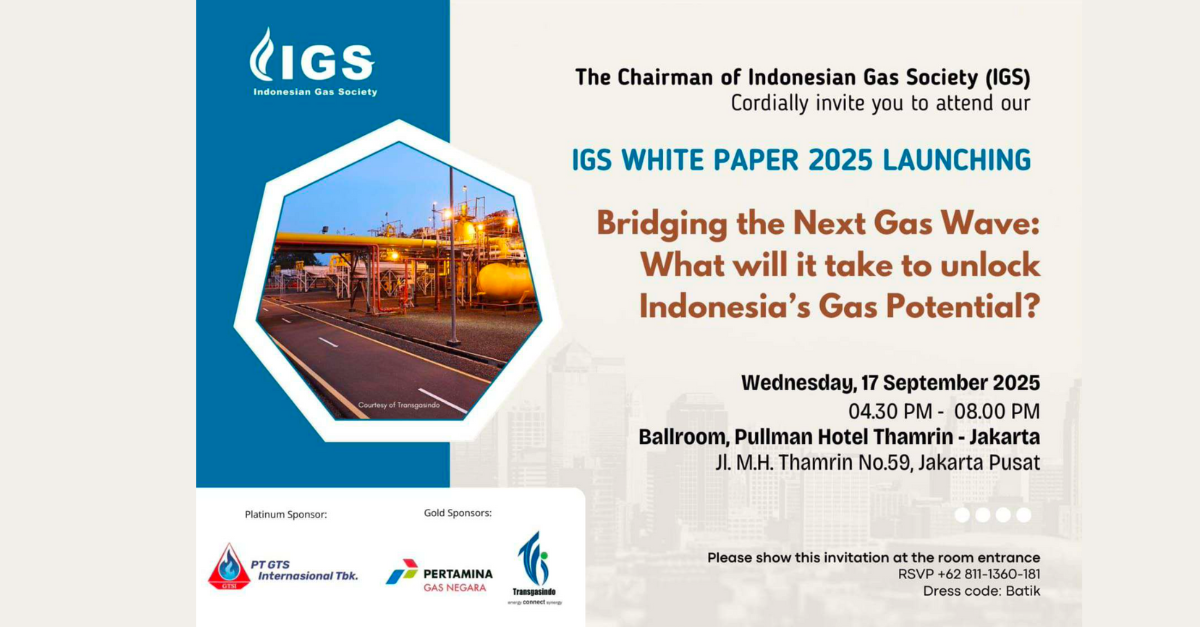
Regarding supply and infrastructure, national gas demand is projected to rise steadily, yet new supply sources are shifting to frontier regions, leading to expected supply tightness until 2028 before mega projects like IDD, Abadi, and Andaman come online. A central challenge remains the fragmented infrastructure, where segmented pipeline networks and highly utilized regasification terminals hinder inter-regional distribution. Consequently, the development of new pipelines such as Cisem and Dusem, alongside streamlined LNG import policies, is deemed critical to ensuring reliable distribution and meeting industrial growth.
On the policy and pricing front, a significant dilemma exists between upstream investors requiring price certainty (USD 7-9/MMBTU) and downstream industries needing affordability (USD 4-6/MMBTU) to remain competitive. To resolve this mismatch, the report proposes shifting to a differentiated pricing strategy through a gas pooling mechanism and cross-subsidies, where strategic sectors receive regulated prices while export markets adopt index-linked formulas. Furthermore, the establishment of a Natural Gas Exchange and a dedicated Gas Pricing Task Force is recommended to create a transparent market balance and strengthen national energy security.
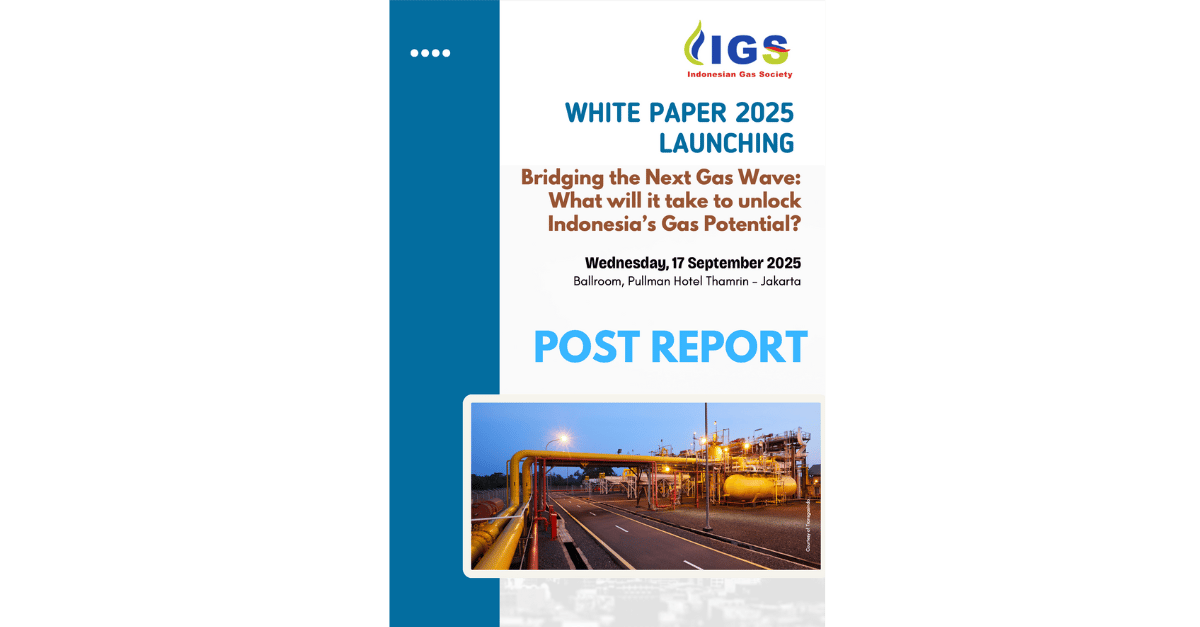

The Indonesian Gas Society (IGS) officially launched its 2nd White Paper in 2025 with the theme "Bridging the Next Gas Wave," designed as a roadmap to navigate the role of natural gas in Indonesia's energy transition toward the net-zero emission target by 2060. Developed in collaboration with Rystad Energy, the document highlights critical areas such as regional LNG supply-demand gaps and emphasizes the urgent need for integrated infrastructure to connect domestic supplies with demand centers, aiming to avoid shortages in key regions like Java and Sumatra.

IGS White Paper 2025 Launching
>
>
>
Regarding supply and infrastructure, national gas demand is projected to rise steadily, yet new supply sources are shifting to frontier regions, leading to expected supply tightness until 2028 before mega projects like IDD, Abadi, and Andaman come online. A central challenge remains the fragmented infrastructure, where segmented pipeline networks and highly utilized regasification terminals hinder inter-regional distribution. Consequently, the development of new pipelines such as Cisem and Dusem, alongside streamlined LNG import policies, is deemed critical to ensuring reliable distribution and meeting industrial growth.
On the policy and pricing front, a significant dilemma exists between upstream investors requiring price certainty (USD 7-9/MMBTU) and downstream industries needing affordability (USD 4-6/MMBTU) to remain competitive. To resolve this mismatch, the report proposes shifting to a differentiated pricing strategy through a gas pooling mechanism and cross-subsidies, where strategic sectors receive regulated prices while export markets adopt index-linked formulas. Furthermore, the establishment of a Natural Gas Exchange and a dedicated Gas Pricing Task Force is recommended to create a transparent market balance and strengthen national energy security.

The Indonesian Gas Society (IGS) officially launched its 2nd White Paper in 2025 with the theme "Bridging the Next Gas Wave," designed as a roadmap to navigate the role of natural gas in Indonesia's energy transition toward the net-zero emission target by 2060. Developed in collaboration with Rystad Energy, the document highlights critical areas such as regional LNG supply-demand gaps and emphasizes the urgent need for integrated infrastructure to connect domestic supplies with demand centers, aiming to avoid shortages in key regions like Java and Sumatra.
IGS White Paper 2025 Launching
>
>
>
Office:
Rasuna Office Park, 3rd Floor Unit TO-07
Complex Rasuna Epicentrum
Jl. HR. Rasuna Said, Kuningan, Jakarta 12960
Tel : +62 21 8378 3757, 8379 5203
Fax : +62 21 8378 1126, 8379 5302
Email : secretariat@indonesiangassociety.com
© 2014. Indonesian Gas Society. All rights reserved.


Mailing Address:
Jl.Kebon Baru 3 No.4 RT.03/RW.09 Tebet, Asem Baris,Jakarta Selatan, 12830