
IGS Launches White Paper 2025 to Unlock Indonesia’s Gas Potential
NEWS
Widodo (Elshinta.com)
9/18/2025
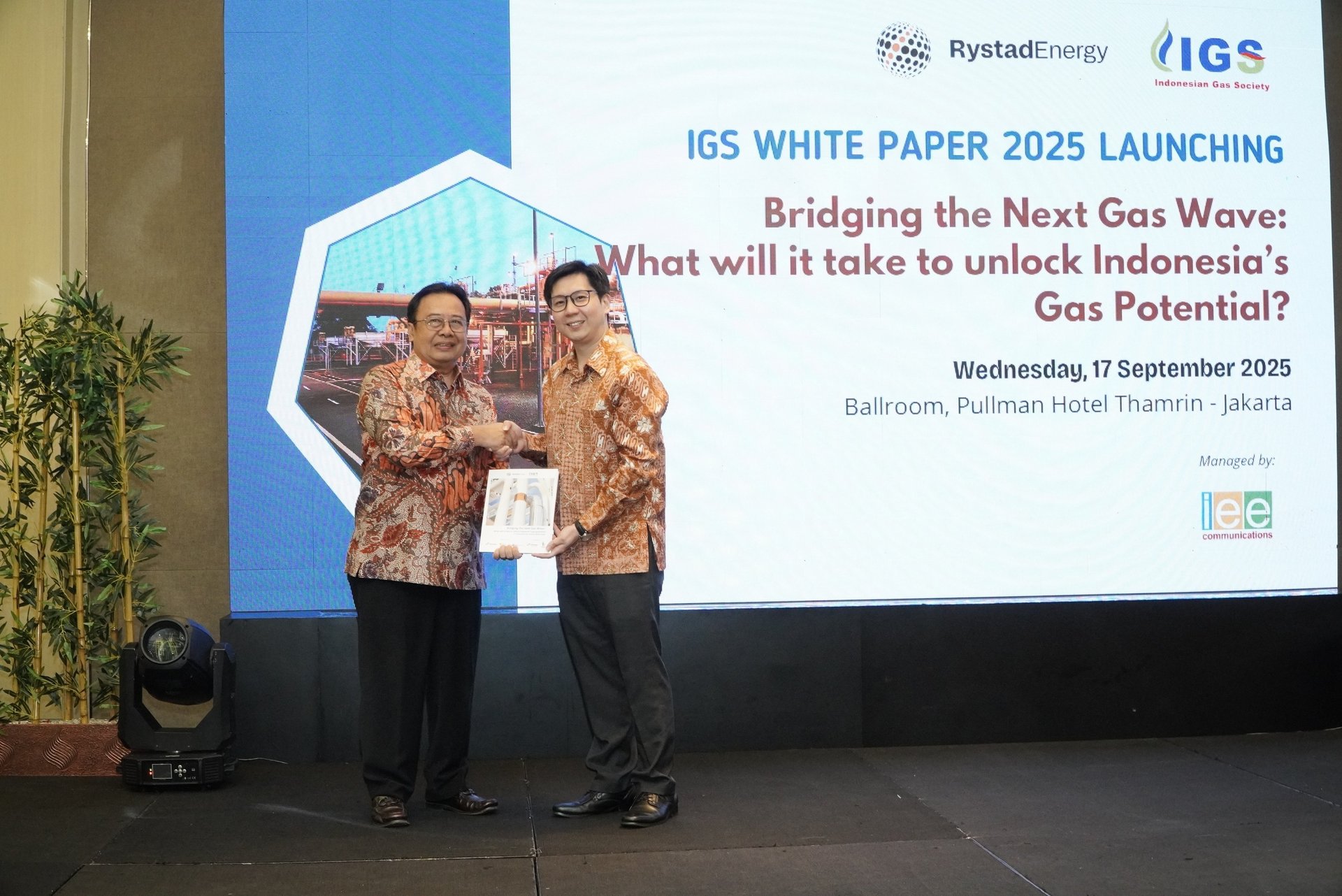
The Indonesian Gas Society (IGS) launched its 2025 White Paper titled "Bridging the Next Gas Wave: What will it take to unlock Indonesia's Gas Potential?" This event aims to strengthen the national gas ecosystem.
"Gas remains important alongside renewable energy. We focus on efficiency, infrastructure strengthening, and low-carbon technology," said Daniel S. Purba, IGS Advisor, at the Pullman Thamrin Hotel in Jakarta, Wednesday (September 17, 2025).
The White Paper emphasizes that gas demand is increasing and Java and Sumatra remain the center of gravity. IGS emphasized the importance of executing strategies to achieve the low-carbon energy transition target. Daniel S. Purba further explained that the gas potential of Andaman and Masela is enormous and strategic.
He explained that institutional coordination needs to be strengthened so that this potential is not just a number, but a reality on the ground. "If coordination is not accelerated, gas reserves will simply be locked away without providing optimal benefits for industrial growth," Daniel said.
Daniel also stated that the low-carbon energy transition cannot be ignored; gas must go hand in hand with renewable energy. He stated that upstream-downstream efficiency, strengthening LNG infrastructure and pipelines, regulatory certainty, domestic pricing, and the adoption of low-carbon technologies are crucial.
"Gas will remain a key pillar of the low-carbon energy transition towards a sustainable future," Daniel emphasized.
Meanwhile, Samuel Low, Partner & Head of APAC Advisory at Rystad Energy, predicts that domestic gas consumption will increase from 3,630 mmscfd in 2025 to 4,830 mmscfd in 2035, primarily supported by the industrial and electricity sectors. After 2045, gas consumption is expected to stabilize at around 5,700 mmscfd.
Java and Sumatra contribute approximately 70% of national gas demand. The balance between gas supply and demand is very tight, and large projects are a major driver. The IDD, Abadi LNG, and Andaman projects are expected to increase gas production from 4,970 mmscfd in 2027 to 7,500 mmscfd in 2032.
Regasification capacity is likely to become insufficient starting in the mid-2030s. LNG demand is projected to exceed national regasification capacity by 2035.
Gas price regulations for the electricity and industrial sectors have been extended until 2029. However, buyers remain at risk if international LNG prices rise without long-term certainty.
The Dumai-Sei Mangkei (DUSEM) pipeline project is scheduled for construction in 2025 and operational in 2027 to transport Andaman gas to Sumatra.
Supply chain optimization and the development of biomethane, CCS/CCUS, and other technologies can support decarbonization.
Three recommended short-term regulatory priorities are:
Accelerating infrastructure development through stronger PPP schemes.
Alignment of LNG procurement objectives and incentives.
Simplification of permitting and infrastructure and distribution development processes.
Achmad Widjaja, Deputy Chairman for Advocacy and Industry of the Indonesian Chamber of Commerce and Industry (ALB), stated that the government needs to promote not only food security but also energy security, especially gas.
Achmad Widjaja emphasized that Indonesia's energy security must be a top priority. He stated that the integration of upstream, midstream, and downstream oil and gas must be immediately strengthened to prevent fragmentation of supply and distribution. "Energy security requires serious attention because without integration in the oil and gas sector, the national industry will continue to struggle to develop," said Achmad Widjaja.
Achmad also emphasized that the government should not rely solely on coal or nickel. He believes that gas must be part of the low-carbon energy transition to achieve industrial and environmental sustainability. "Coal faces significant obstacles, especially because ESG standards restrict exports to Europe and the United States," Achmad concluded.

>
IGS Launches White Paper 2025 to Unlock Indonesia’s Gas Potential
>
>
The Indonesian Gas Society (IGS) launched its 2025 White Paper titled "Bridging the Next Gas Wave: What will it take to unlock Indonesia's Gas Potential?" This event aims to strengthen the national gas ecosystem.
"Gas remains important alongside renewable energy. We focus on efficiency, infrastructure strengthening, and low-carbon technology," said Daniel S. Purba, IGS Advisor, at the Pullman Thamrin Hotel in Jakarta, Wednesday (September 17, 2025).
The White Paper emphasizes that gas demand is increasing and Java and Sumatra remain the center of gravity. IGS emphasized the importance of executing strategies to achieve the low-carbon energy transition target. Daniel S. Purba further explained that the gas potential of Andaman and Masela is enormous and strategic.
He explained that institutional coordination needs to be strengthened so that this potential is not just a number, but a reality on the ground. "If coordination is not accelerated, gas reserves will simply be locked away without providing optimal benefits for industrial growth," Daniel said.
Daniel also stated that the low-carbon energy transition cannot be ignored; gas must go hand in hand with renewable energy. He stated that upstream-downstream efficiency, strengthening LNG infrastructure and pipelines, regulatory certainty, domestic pricing, and the adoption of low-carbon technologies are crucial.
"Gas will remain a key pillar of the low-carbon energy transition towards a sustainable future," Daniel emphasized.
Meanwhile, Samuel Low, Partner & Head of APAC Advisory at Rystad Energy, predicts that domestic gas consumption will increase from 3,630 mmscfd in 2025 to 4,830 mmscfd in 2035, primarily supported by the industrial and electricity sectors. After 2045, gas consumption is expected to stabilize at around 5,700 mmscfd.
Java and Sumatra contribute approximately 70% of national gas demand. The balance between gas supply and demand is very tight, and large projects are a major driver. The IDD, Abadi LNG, and Andaman projects are expected to increase gas production from 4,970 mmscfd in 2027 to 7,500 mmscfd in 2032.
Regasification capacity is likely to become insufficient starting in the mid-2030s. LNG demand is projected to exceed national regasification capacity by 2035.
Gas price regulations for the electricity and industrial sectors have been extended until 2029. However, buyers remain at risk if international LNG prices rise without long-term certainty.
The Dumai-Sei Mangkei (DUSEM) pipeline project is scheduled for construction in 2025 and operational in 2027 to transport Andaman gas to Sumatra.
Supply chain optimization and the development of biomethane, CCS/CCUS, and other technologies can support decarbonization.
Three recommended short-term regulatory priorities are:
Accelerating infrastructure development through stronger PPP schemes.
Alignment of LNG procurement objectives and incentives.
Simplification of permitting and infrastructure and distribution development processes.
Achmad Widjaja, Deputy Chairman for Advocacy and Industry of the Indonesian Chamber of Commerce and Industry (ALB), stated that the government needs to promote not only food security but also energy security, especially gas.
Achmad Widjaja emphasized that Indonesia's energy security must be a top priority. He stated that the integration of upstream, midstream, and downstream oil and gas must be immediately strengthened to prevent fragmentation of supply and distribution. "Energy security requires serious attention because without integration in the oil and gas sector, the national industry will continue to struggle to develop," said Achmad Widjaja.
Achmad also emphasized that the government should not rely solely on coal or nickel. He believes that gas must be part of the low-carbon energy transition to achieve industrial and environmental sustainability. "Coal faces significant obstacles, especially because ESG standards restrict exports to Europe and the United States," Achmad concluded.
>
IGS Launches White Paper 2025 to Unlock Indonesia’s Gas Potential
>
>
Office:
Rasuna Office Park, 3rd Floor Unit TO-07
Complex Rasuna Epicentrum
Jl. HR. Rasuna Said, Kuningan, Jakarta 12960
Tel : +62 21 8378 3757, 8379 5203
Fax : +62 21 8378 1126, 8379 5302
Email : secretariat@indonesiangassociety.com
© 2014. Indonesian Gas Society. All rights reserved.

Mailing Address:
Jl.Kebon Baru 3 No.4 RT.03/RW.09 Tebet, Asem Baris,Jakarta Selatan, 12830