
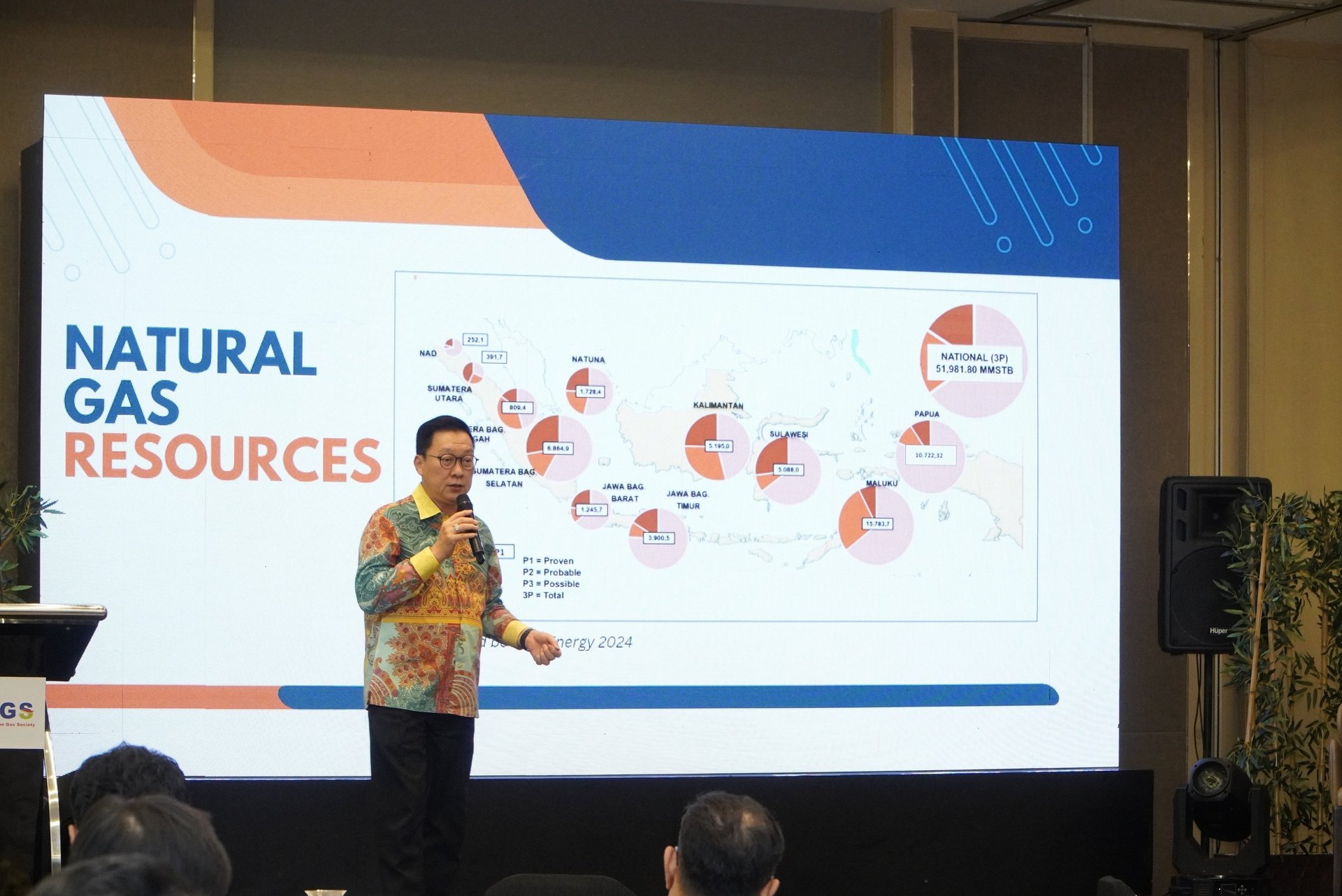
IGS: Infrastructure Acceleration and Regulation as Key Gas Sector Drivers
NEWS
Andi Syafriadi (Akurat.co)
9/17/2025
Indonesia's gas-based energy security requires swift execution of infrastructure development and regulatory certainty. This was emphasized by the Indonesian Gas Society (IGS) at the launch of its 2025 White Paper in Jakarta on Wednesday (September 17, 2025).
In the document, IGS recommends accelerating gas infrastructure development through a stronger public-private partnership (PPP) scheme, aligning LNG procurement objectives, and simplifying permitting with a single-window licensing system.
Achmad Wijadja, Deputy Chairman for Advocacy and Industry of the Indonesian Chamber of Commerce and Industry (ALB), explained that the business community hopes the government will be more consistent in providing regulatory certainty.
"Investment in the gas sector requires long-term certainty. Without stable regulations and adequate infrastructure, industry will struggle to access energy at competitive prices," he said.
He further added that regulatory certainty will also increase investor interest in gas infrastructure development.
"We need a bankable scheme so that pipeline projects, LNG terminals, and low-carbon technology can proceed on target," Achmad said.
As is known, the Dumai-Sei Mangkei pipeline project, scheduled for operation in 2027, is a priority. However, potential bottlenecks on the Belawan pipeline must be anticipated to avoid disruptions to Andaman gas distribution.
On the other hand, regasification capacity is expected to decrease starting in the mid-2030s. The LNG terminal in West Java is projected to operate at near 100% utilization, while the Teluk Lamong terminal, targeted for completion in 2025, is unable to accommodate the surge in demand.
The pricing policy context is also under scrutiny. The gas price regulations for the electricity and industrial sectors, extended until 2029, are deemed insufficient to provide long-term certainty, especially if international LNG prices rise.
"Regulation and infrastructure are key. Without them, it will be difficult to maintain a balance between increasing domestic demand and limited supply," the 2025 White Paper states.
IGS also emphasizes low-carbon technology innovation, including the development of biomethane, CCS/CCUS, hydrogen, and blue ammonia, as tactical solutions to support the decarbonization of the energy sector.

>
IGS: Infrastructure Acceleration and Regulation as Key Gas Sector Drivers
>
>
Indonesia's gas-based energy security requires swift execution of infrastructure development and regulatory certainty. This was emphasized by the Indonesian Gas Society (IGS) at the launch of its 2025 White Paper in Jakarta on Wednesday (September 17, 2025).
In the document, IGS recommends accelerating gas infrastructure development through a stronger public-private partnership (PPP) scheme, aligning LNG procurement objectives, and simplifying permitting with a single-window licensing system.
Achmad Wijadja, Deputy Chairman for Advocacy and Industry of the Indonesian Chamber of Commerce and Industry (ALB), explained that the business community hopes the government will be more consistent in providing regulatory certainty.
"Investment in the gas sector requires long-term certainty. Without stable regulations and adequate infrastructure, industry will struggle to access energy at competitive prices," he said.
He further added that regulatory certainty will also increase investor interest in gas infrastructure development.
"We need a bankable scheme so that pipeline projects, LNG terminals, and low-carbon technology can proceed on target," Achmad said.
As is known, the Dumai-Sei Mangkei pipeline project, scheduled for operation in 2027, is a priority. However, potential bottlenecks on the Belawan pipeline must be anticipated to avoid disruptions to Andaman gas distribution.
On the other hand, regasification capacity is expected to decrease starting in the mid-2030s. The LNG terminal in West Java is projected to operate at near 100% utilization, while the Teluk Lamong terminal, targeted for completion in 2025, is unable to accommodate the surge in demand.
The pricing policy context is also under scrutiny. The gas price regulations for the electricity and industrial sectors, extended until 2029, are deemed insufficient to provide long-term certainty, especially if international LNG prices rise.
"Regulation and infrastructure are key. Without them, it will be difficult to maintain a balance between increasing domestic demand and limited supply," the 2025 White Paper states.
IGS also emphasizes low-carbon technology innovation, including the development of biomethane, CCS/CCUS, hydrogen, and blue ammonia, as tactical solutions to support the decarbonization of the energy sector.
>
IGS: Infrastructure Acceleration and Regulation as Key Gas Sector Drivers
>
>
Office:
Rasuna Office Park, 3rd Floor Unit TO-07
Complex Rasuna Epicentrum
Jl. HR. Rasuna Said, Kuningan, Jakarta 12960
Tel : +62 21 8378 3757, 8379 5203
Fax : +62 21 8378 1126, 8379 5302
Email : secretariat@indonesiangassociety.com
© 2014. Indonesian Gas Society. All rights reserved.

Mailing Address:
Jl.Kebon Baru 3 No.4 RT.03/RW.09 Tebet, Asem Baris,Jakarta Selatan, 12830